
How to Learn the Guitar Fretboard (Without Memorising a Chart)
Learning the guitar fretboard means being able to name any note on any string without counting up from the nut. The quickest route is to learn the natural notes on the low E and A strings, then use octave shapes to find those same notes on the other four strings. Ten minutes a day is enough to get there in about two months.
What learning the fretboard actually means
Fretboard memorisation has a poor reputation — not because it's hard, but because the standard advice makes it harder than it needs to be. Most guitarists are shown a chart of every note on the neck and told to commit it to memory. They try. They fail. They conclude the fretboard is beyond them.
It isn't. The fretboard is built on a handful of repeating patterns, and once those patterns are visible the note names fill in quickly and stay. Knowing the fretboard doesn't mean reciting seventy-odd positions on demand. It means three practical things:
- You can name the note under any finger within a couple of seconds.
- Given a note name, you can find it on every string in the first twelve frets.
- You can see how notes relate to each other — which one is the octave, which one is a fifth above — without working it out from scratch.
The first two are recall. The third is navigation, and it's the one that makes the other two fast. This guide builds all three in that order.
Why fretboard knowledge matters
Most intermediate players get by without knowing the notes. They know shapes; they can play songs. But without note names there's a ceiling on what's possible:
- Talking to other musicians. “Play a G” or “it's in D” means nothing if you don't know where G or D is.
- Building chords. Any chord starts from its root. If you can't find the root, you can only play the chords you've memorised as shapes.
- Using theory in real time. CAGED, intervals and triads all assume quick note recall. Without it they stay on paper.
- Transposing. Moving a riff or progression to a new key is guesswork unless you know which note is where.
If you've stopped improving and can't say why, this is usually the first gap; the guide to getting past a guitar plateau has a quick self-check. Fretboard knowledge isn't academic. It's the difference between playing by feel and playing with understanding — and every other topic in Guitarion's guides sits on top of it.
Start with what's already there
There's more to start with than most players realise. The six open strings — E, A, D, G, B, E, from lowest to highest — are already known. The 12th fret is the octave of each, which doubles the count immediately. That's twelve note positions without learning anything new. If the strings aren't in tune yet, our free online guitar tuner will sort that first.

The six open strings — the foundation of everything on the neck
The 12th fret matters for a second reason. Because it's the octave of the open string, frets 12 to 24 are an exact copy of frets 0 to 12, one octave higher. Learn the first twelve frets and the rest of the neck is already known. Most players don't realise this until someone points it out.
The musical alphabet: twelve notes, two gaps
Western music uses twelve notes: seven natural notes (A B C D E F G) and five sharps or flats between them. Together they form the chromatic scale, and it repeats indefinitely in both directions. On the guitar, each fret is one step along that sequence — a semitone.
Two facts are worth committing to memory before anything else: there's no sharp between B and C, and no sharp between E and F. Every other pair of natural notes has a fret between them. Those two gaps are the navigational landmarks that prevent most errors, and they're the reason the low E string's first two notes, E and F, sit on neighbouring frets.

Written with sharps

Written with flats
Every sharp is also a flat: the fret above F is F, and it's also the fret below G, so it's G♭ too. The name you use depends on the key you're in, not on the fret. That's why the right order is naturals first. Once the seven natural notes are solid on a string, the sharps and flats fill in automatically — always one fret above or below a natural you already know.
Start with the low E and A strings
The temptation is to learn all six strings at once. Resist it. Two strings learned properly will do more for you than six half-remembered, and the low E and A are the two to pick. They carry the roots of almost every barre chord and power chord you'll play, and — as the next section shows — they act as reference points for the other four strings.
On the low E string the natural notes are: E (open), F (1), G (3), A (5), B (7), C (8), D (10), E (12). On the A string: A (open), B (2), C (3), D (5), E (7), F (8), G (10), A (12). Notice where the half-steps fall: E–F on the low E string and B–C on the A string are neighbouring frets, exactly as the musical alphabet predicts.
Natural notes on the low E and A strings, frets 0–12 — learn these first
Learn them the slow way: play each note, say its name out loud, move on. Then do it in reverse, from the 12th fret back to the nut. Then call out a note at random and find it. Saying the name matters more than it seems — it forces recall rather than recognition, and recall is what you need mid-song.
Landmark frets do half the work
Guitar necks have inlay markers at frets 3, 5, 7, 9 and 12. They aren't decoration. They're anchors, and the notes at those frets are the first ones worth knowing on every string.
Fret 5 is particularly useful. From the low E string to the high e, it gives A, D, G, C, E, A. Look at A, D, G and E: each is the open string above. That's not a coincidence — it's how standard tuning works. Each string is tuned five frets (a perfect fourth) above the one below it, with one exception: the B string is only four frets (a major third) above the G string. That's why the odd one out is C, on the G string — the G string matches the open B at the 4th fret, not the 5th. That single exception will come up again. (Retune any string and these distances change: the alternate guitar tunings guide shows which notes move.)
The 5th fret (solid) and 7th fret (outlined) across all six strings
Fret 7 is the other landmark worth learning early: B, E, A, D, F, B. With frets 0, 5, 7 and 12 in place on the low E and A strings, nothing on those strings is more than two frets from a note you know instantly.
Octave shapes: find any note on every string
The fastest way to extend fretboard knowledge beyond two strings is the octave shape. An octave is the same note, higher. On the guitar, the same note reappears in predictable places, and once you can see those places, knowing a note on the low E or A string means knowing it on four other strings.
The rules are short:
- Two strings up, two frets forward — from the low E string to the D string, and from the A string to the G string.
- Two strings up, three frets forward — from the D string to the B string, and from the G string to the high e. The extra fret is the G–B tuning exception at work.
- Same fret, five strings up — the low E and high e strings carry identical note names at every fret, two octaves apart.
Take A at the 5th fret of the low E string. Two strings up, two frets forward: the 7th fret of the D string — also A. Two more strings up, three frets forward: the 10th fret of the B string — A again. And the 5th fret of the high e is A as well. One note, found four ways from a single reference point.
From A on the low E string (green): +2 frets to the D string, +3 more to the B string, same fret on the high e
The A string works the same way. C sits at the 3rd fret of the A string. Two strings up, two frets forward: C at the 5th fret of the G string. Two more strings up, three frets forward: C at the 8th fret of the high e. There's also a shortcut downwards: from the A string to the B string, the octave sits two frets back — C at the 1st fret of the B string.
From C on the A string (green): forward to the G and high e strings, or two frets back to the B string
Drill these with every natural note on the low E and A strings. Within a week or two, any note on any string becomes findable from a reference point you already know. It's not memorisation — it's navigation.
One note, everywhere
Octave shapes connect notes in pairs. The next step is to see every instance of one note at once. Pick a note — C, say — and find it on all six strings between the nut and the 12th fret. In that range each note appears once per string (the open string and 12th fret being the same note, an octave apart).
Every C between the nut and the 12th fret
Play them low to high, then high to low, saying “C” each time. Then pick another natural note and do the same. Time yourself if it helps: the goal is all six in a few seconds, without stopping to count. When the naturals are quick, do the same with the sharps and flats.
This drill is also where the octave shapes stop being rules and start being something you see. The C on the A string (fret 3) and the C on the G string (fret 5) are the two-strings-up, two-frets-forward shape. The C on the G string and the C on the high e (fret 8) are the three-fret version across the G–B break. The pattern is the same for every note; only its position changes.
How the fretboard connects to everything else
Learning the fretboard in isolation is slow and joyless. The faster route is to attach note names to things you already play, so every practice session doubles as fretboard practice. It also works the other way: every other topic gets easier once the notes are known.
Intervals: measure from the root
An interval is the distance between two notes, and the octave shapes above are intervals already. So is the 5th-fret rule: five frets up one string is a perfect fourth, which is why it lands on the next open string. Learning guitar intervals as fretboard shapes turns note-finding into something faster than recall: you find the root, then measure from it. Training your ear on the same shapes, as in our ear training method for intermediate players, means you start hearing the distances as well as seeing them.
The CAGED system
Every CAGED shape is built around roots on particular strings. The E shape has its root on the low E string; the A shape and C shape on the A string; the D shape on the D string; the G shape on the low E string (with octaves on the G and high e strings). If you can find a note on the low E, A and D strings, you can place any of the five CAGED shapes for any chord. Naming the root every time you play one is the best fretboard exercise there is.
Triads: name every chord tone
A triad is three notes: root, third and fifth. C major is C, E and G — and on the top three strings you'll find them at the 5th fret of the G string (C), the 5th fret of the B string (E) and the 3rd fret of the high e (G). Name all three every time you play a triad and you're no longer playing a shape; you're choosing notes. That's the core idea behind using triads across the neck.
The pentatonic scale
The first A minor pentatonic position sits between the 5th and 8th frets, with its root at the 5th fret of the low E string. Its notes are A, C, D, E and G — all naturals, which makes it ideal for fretboard practice. Play the position slowly, naming each note, and you're practising scale, fretboard and theory at once. The pentatonic scale guide covers all five positions.
A minor pentatonic, first position, every note named — roots in green
Once that position is comfortable with names attached, the next step is connecting it to the rest of the neck — covered in how to break out of the pentatonic box. Scale shapes become note maps once the names are attached, and a note map tells you what key you're in, which notes are chord tones, and where to land.
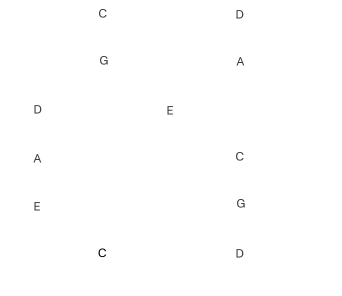
The same idea in C major pentatonic, around the 8th fret
Common mistakes
Trying to learn all six strings at once
It feels efficient and isn't. Six strings learned in parallel means six strings half-learned. Two strings learned properly, plus octave shapes, gets you further in less time.
Counting up from the nut
Counting “E, F, F sharp, G…” until you reach the note you want gets the right answer, slowly, and it never gets faster. Use landmarks instead: if you know the 5th and 7th frets, the 6th is one step from either.
Forgetting the two missing sharps
B–C and E–F are a single fret apart. Assume there's a sharp between them and every note after that point is one fret out.
Forgetting the G–B shift
Octave shapes that cross from the G string to the B string need one extra fret. It catches players out more than anything else on the neck, mostly because the lower strings train you to expect two.
Practising silently
Playing the notes without naming them builds finger memory, not note knowledge. Say every note out loud. It feels awkward for a day or two and then it's the fastest part of the method.
Keeping it separate from playing
Note drills that never touch music get dropped. Ten minutes of drilling plus naming the roots of the chords you're already playing beats an hour of drilling on its own.
An eight-week practice plan
Ten minutes a day is enough. Each week adds one thing and keeps the previous week's work as a warm-up. To fit it into a wider session, the intermediate practice routine gives fretboard work its own day each week.
- Week 1 — The low E string. Natural notes, frets 0–12, said aloud: up, down, then at random. Learn frets 0, 5, 7 and 12 (E, A, B, E) until they're instant.
- Week 2 — The A string. Same routine. Then drill the two strings in pairs: at fret 3 it's G and C, at fret 5 A and D, at fret 7 B and E, at fret 8 C and F, at fret 10 D and G.
- Week 3 — Octaves to the D and G strings. For every natural note on the low E and A strings, find its octave two strings up and two frets forward. Name both notes.
- Week 4 — Octaves to the B and high e strings. Extend each octave shape across the G–B break (three frets forward), and add the A-to-B shortcut (two frets back). Note that the high e mirrors the low E.
- Week 5 — One note, everywhere. Each day, pick two natural notes and find each on all six strings, frets 0–12. Work through all seven naturals by the end of the week.
- Week 6 — Sharps and flats. Repeat the one-note drill with the five accidentals, naming each both ways (F / G♭).
- Week 7 — Chord roots. Play barre chords and CAGED shapes and name the root of every one before you strum it. Move a simple progression to two new keys.
- Week 8 — Scale positions with names. Play the first A minor pentatonic position naming every note, then a second position. You're now practising the fretboard without setting time aside for it.
By the end, fretboard knowledge isn't a separate skill — it's woven into everything else you practise. The notes were always under your fingers. This is just learning what they're called.
Fretboard notes chart
Here are the natural notes on every string from the nut to the 12th fret. Use it to check yourself, not to memorise from: the point of the method above is that you work these out from the low E and A strings and the octave shapes.
Natural notes on every string, frets 0–12. Sharps and flats sit on the frets in between.
Prefer paper? Download the printable fretboard notes chart (PDF), an A4 sheet with every C highlighted.
Quick reference
Natural notes, frets 0–12
| String | Natural notes (fret) |
|---|---|
| High e (1st) | E 0 · F 1 · G 3 · A 5 · B 7 · C 8 · D 10 · E 12 |
| B (2nd) | B 0 · C 1 · D 3 · E 5 · F 6 · G 8 · A 10 · B 12 |
| G (3rd) | G 0 · A 2 · B 4 · C 5 · D 7 · E 9 · F 10 · G 12 |
| D (4th) | D 0 · E 2 · F 3 · G 5 · A 7 · B 9 · C 10 · D 12 |
| A (5th) | A 0 · B 2 · C 3 · D 5 · E 7 · F 8 · G 10 · A 12 |
| Low E (6th) | E 0 · F 1 · G 3 · A 5 · B 7 · C 8 · D 10 · E 12 |
Octave shapes
| From | To | Move | Example |
|---|---|---|---|
| Low E (6th) | D (4th) | 2 frets forward | A: fret 5 → fret 7 |
| A (5th) | G (3rd) | 2 frets forward | C: fret 3 → fret 5 |
| D (4th) | B (2nd) | 3 frets forward | A: fret 7 → fret 10 |
| G (3rd) | High e (1st) | 3 frets forward | C: fret 5 → fret 8 |
| A (5th) | B (2nd) | 2 frets back | C: fret 3 → fret 1 |
| Low E (6th) | High e (1st) | Same fret | A: fret 5 → fret 5 |
Landmark frets
| Fret | Low E → high e |
|---|---|
| 0 / 12 | E · A · D · G · B · E |
| 5 | A · D · G · C · E · A |
| 7 | B · E · A · D · F · B |
Fretboard FAQs
How long does it take to learn the guitar fretboard?
With ten minutes of focused practice a day, the eight-week plan in this guide gets you finding any natural note on any string. Speed keeps improving for months afterwards, mostly through naming notes in everyday playing. The players who take years are usually the ones still counting up from the nut.
Do I need to memorise every note on the fretboard?
No. Learn the natural notes on the low E and A strings properly, then use octave shapes to find the same notes on the other four strings. Sharps and flats sit one fret either side of a natural note, so they come almost for free.
What is the fastest way to learn the notes on the guitar?
Anchor two strings, then navigate from them. Say each note aloud as you play it, use the 5th, 7th and 12th frets as landmarks, and practise finding one note on all six strings until it takes a few seconds. Short daily sessions work better than long weekly ones.
Do I need to learn the notes above the 12th fret?
Not separately. The 12th fret is an octave above the open strings, so frets 12 to 24 repeat frets 0 to 12 exactly, one octave higher. A at the 5th fret of the low E string is A again at the 17th.
Should I learn sharps or flats first?
Learn the natural notes first, because sharps and flats are named relative to them: F sharp is one fret above F, and B flat is one fret below B. Which name you use depends on the key, so get comfortable with both. F sharp and G flat are the same fret.
Should I learn the fretboard?
Yes, if you want to understand what you play rather than only copy it. Knowing the notes is what lets you build chords from any root, move songs into new keys and use CAGED, intervals and scales deliberately. You don't need it to strum songs, but it's the foundation for everything else in these guides.
How can I learn the fretboard fast?
Keep sessions short and test yourself instead of re-reading a chart. Five to ten minutes a day of timed recall, naming random notes on one string until it's quick, beats an hour of staring at diagrams. Then use the notes straight away: name the root of every chord you play that week.